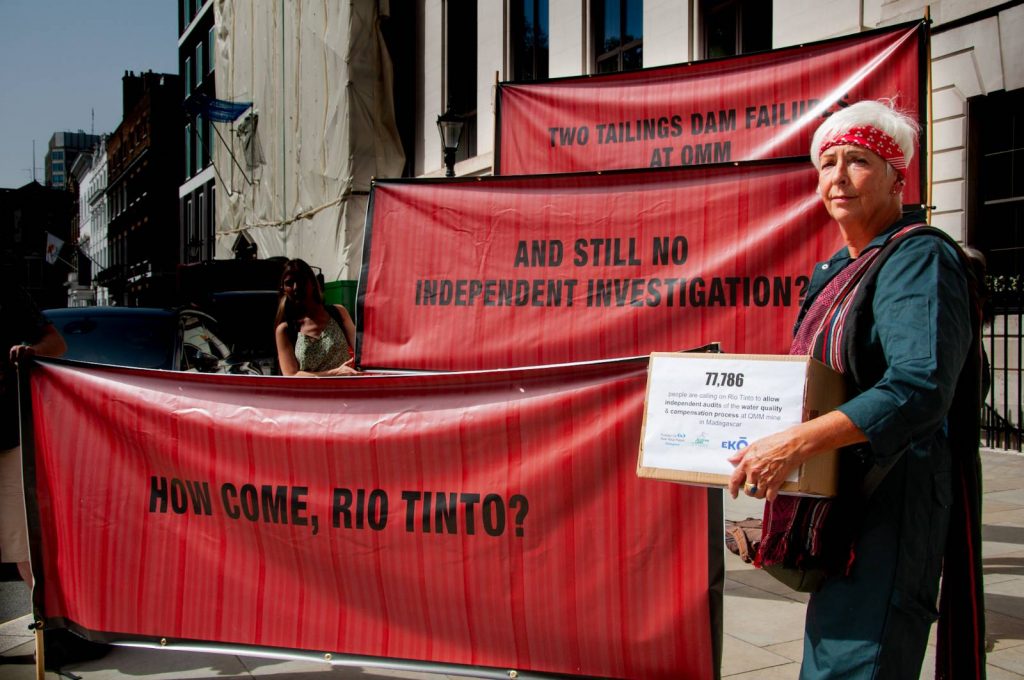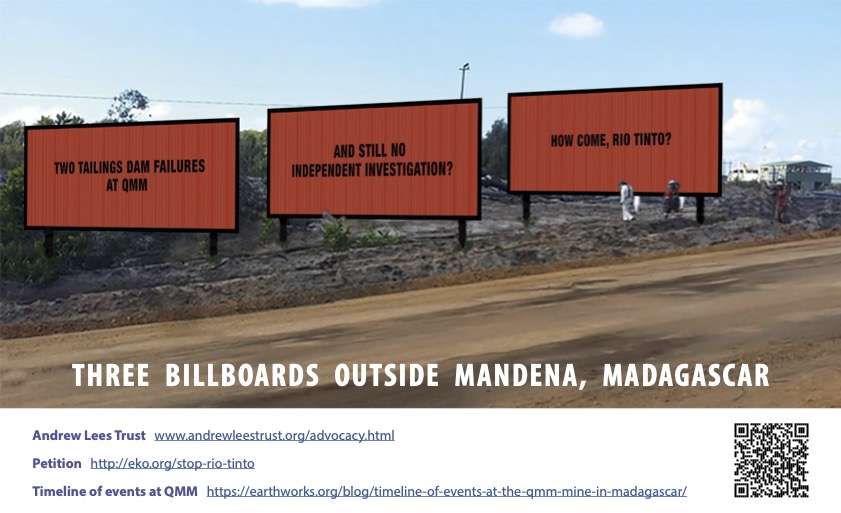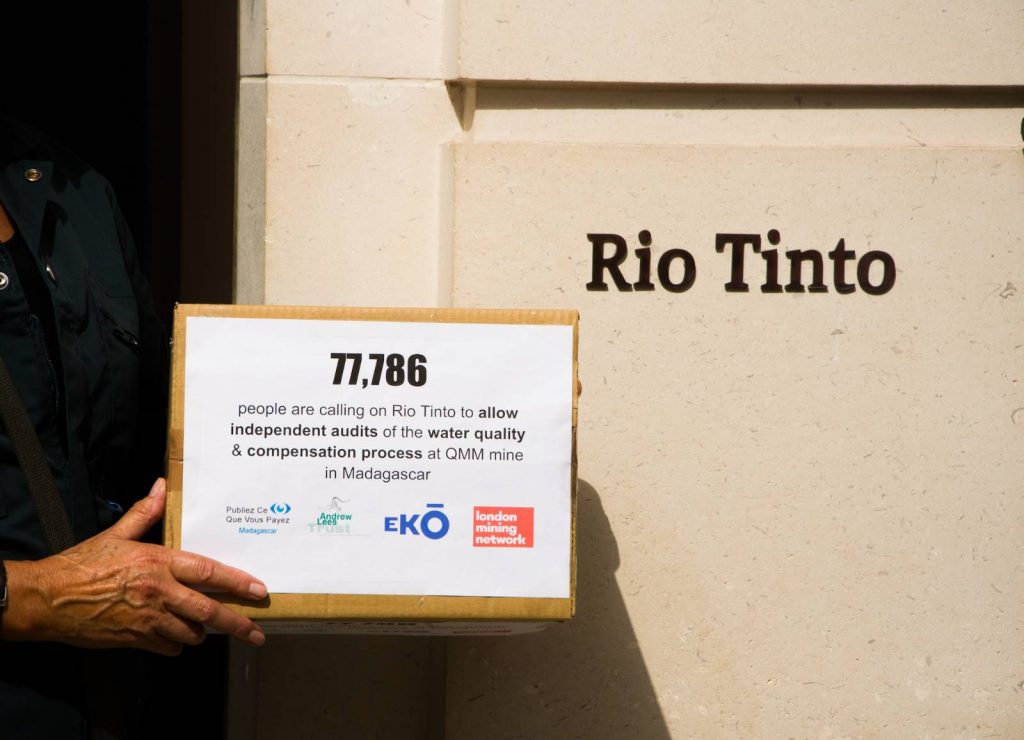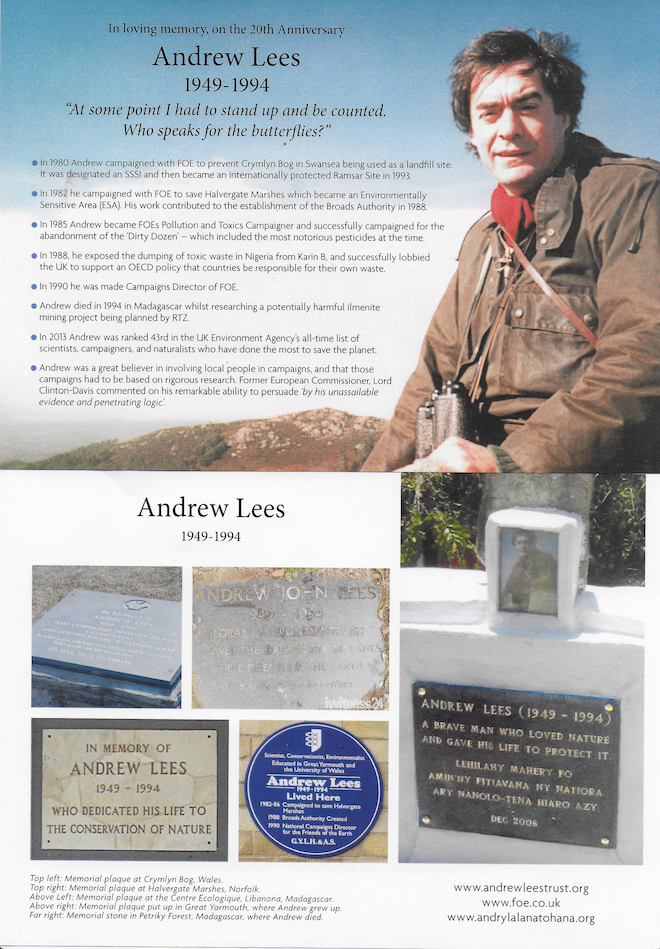
authored by Yvonne Orengo
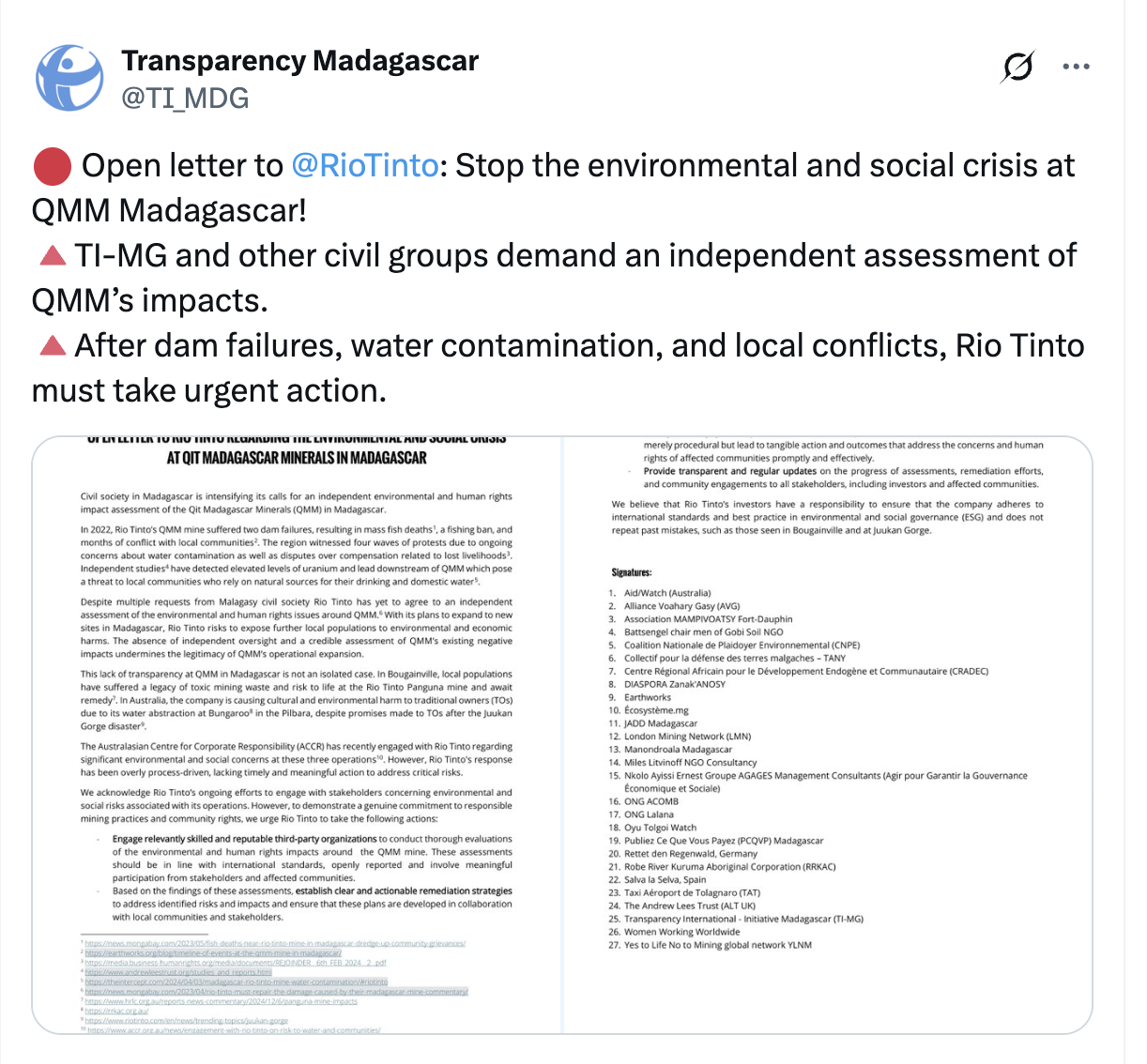
Transparency International Initiative in Madagascar (TI IMG) has published an open letter signed by 27 local, national and international organisations and associations demanding an independent environmental and human rights impact assessment of Rio Tinto’s QMM mine in Madagascar.
English version of the Open Letter can be downloaded HERE / and with intro from ALT UK HERE
Malagasy version of the Open Letter available HERE
French version available HERE
Investor Briefing on QMM HERE
The sections below this introduction represents a long read. Key points of discussion include:
- Rio Tinto has refused demands from Malagasy civil society organisations (CSOs)for an independent impact assessment. The hope of CSOs is for an open and inclusive process along similar lines to the Panguna impact assessment , Bougainville. This type of independent assessment has been deemed necessary and requested in different ways, multiple times over numerous years because many issues, especially human rights, social issues, grievance and compensation processes around QMM have not been addressed since the mine began, according to local communities (ROHY 2023).
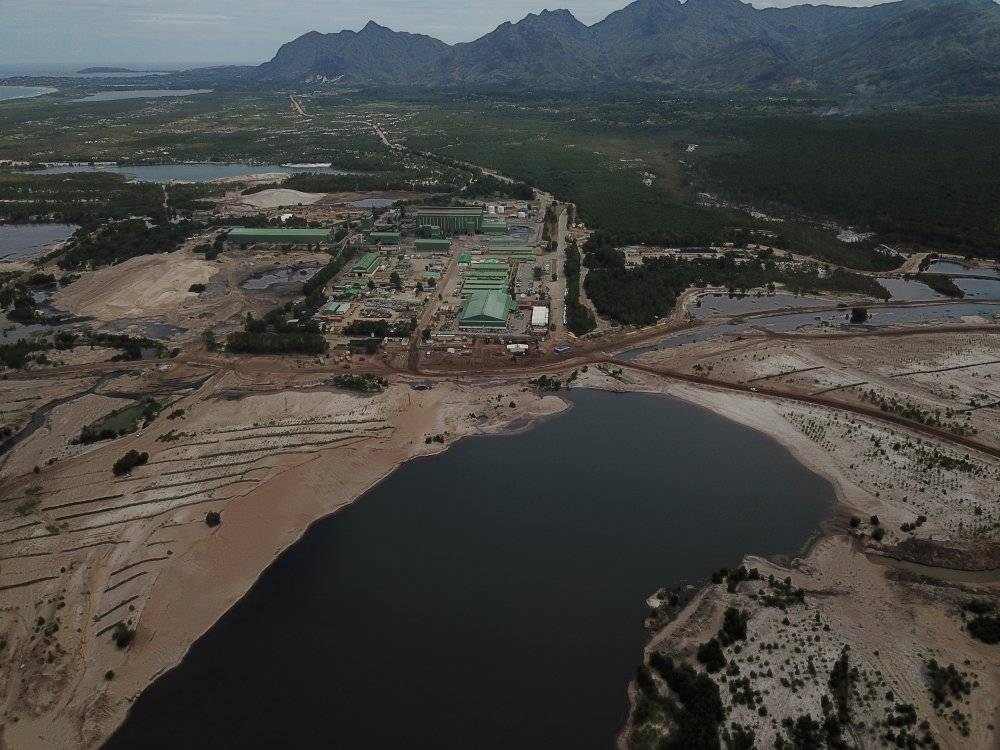
- Contestation and concerns over water quality relate to the impacts of the QMM weir on the local lake chemistry (impacts on fish stocks and fisheries since 2007), as well as toxic contaminants (eg elevated uranium, lead, aluminium, cadmium) detected at levels that present health risks to local people and the health of their environment (2019-2021). A breach of a protective environmental zone by QMM in 2014, which placed QMM mine tailings permanently in the local lake, tailings dam failures, the appearance of dead fish and a fishing ban in 2022, have escalated these concerns.
- Where the company has been conducting water and radiation studies and making assurances, many questions remain. Experts who have reviewed QMM’s annual water report (2021-2023) and its commissioned JBS&G radiation study have demonstrated that the reports’ conclusions are not supported by the data and lack evidence.
- There have been five conflicts since 2021 over water quality and related issues. In 2023, the shooting of three protestors who were demanding clemency for their leaders (under arrest warrants for organising protests against QMM) has sent a chilling message to those in rural communities next to the mine who have lost trust in QMM over many years and remain dissatisfied with QMM’s response to the challenges they face as a direct result of mine impacts. This includes loss of land, loss of access to natural resources, lost livelihoods and loss of income since the mine started, which for communities who are largely subsistence farmers and fisherfolk and dependent on natural resources and natural waterways, has undermined their food security and survival.
- The loss of trust and the conflicts locally (since the mine began) are why an independent environmental and human rights impact assessment is so critical to ensure improved communications, inclusivity, governance and transparency, and thereby greater regional stability.
The following content explores these issues in more detail and includes links to studies and articles:
The Ask
The civil society Open Letter and their demand comes just ahead of the Rio Tinto London AGM on 3rd April. It is not the first request the company has received from Malagasy civil society calling for some form of audit and/or external assessment of QMM, some of which can be documented at least as far back as 2019. Almost all have cited social and or environmental impacts of the mine in relation to harm or hardships experienced by the mine affected rural populations.
According to research undertaken by Publish What You Pay Madagascar, PWYP MG, 2022, 94% of such rural community members interviewed reported negative impacts from the mine, largely related to loss of natural resources, livelihoods and water quality. More than 66% believe water quality had deteriorated in the last ten years, and 55% attribute this degradation to pollution from QMM’s mine.
In 2023, Ketakandriana (aka ‘Ke’) Rafitoson, then Director of Transparency International Initiative Madagascar and leading the Publish What You Pay coalition in Madagascar, travelled to the UK to attend the Rio Tinto AGM. She raised human rights issues and asked the Board publicly for independent assessment of QMM. She was also interviewed about the QMM issues and made public calls for the company to be subject to greater transparency and accountability.
Rio Tinto, while making assurances to Ke and the Malagasy people that it is dealing with issues at QMM, has remained intransigent, adamantly denying the demands of its host communities for independent assessments of any kind.

Rio Tinto claims it is doing enough to address the issues that have been raised while at the same time insisting there are no negative impacts of QMM and no health concerns. Aside from an inherent contradiction in this position, there seems to be a loss of memory as to why it might be challenging for stakeholders to trust the company’s verbal assurances and assertions.
Malagasy media cover the Open Letter HERE and HERE
Backtracking
Rio Tinto has had to backtrack on various assertions and concede numerous failings about QMM in recent years. For example, QMM’s breach of an environmental buffer zone . The admission to the breach came in 2019 after two years of the company’s adamant denials and its assurances of QMM’s compliance, despite compelling evidence to the contrary from an independent study using NASA satellite data. The company then claimed there was ‘no significant impact’ from the breach. However, after more inquiry Rio Tinto later had to concede there was no technical study to support this claim.
In 2019, The discovery of QMM’s lack of radiation monitoring in the wider environment exposed more than a decade of unfounded QMM assurances that there was no risk of radiation exposure to local people (mineral sands are rich in radionuclides which are concentrated in the extraction process through churning of the sands). QMM had not been monitoring any ingestion pathways or radiation exposure risks in the wider environment to support its claims.
In 2021 QMM was forced to concede that its ‘natural” or “passive” water management system was not working. QMM’s assurances that its series of settling ponds would sorb all the contaminants from QMM mine process wastewater was shown to be wishful thinking, when independent analysis of QMM’s data clearly demonstrated the system was instead concentrating the contaminants before release into the environment. That water system had already been operating for more than a decade.
QMM has subsequently installed a new treatment plant designed to address the high aluminium and low pH in its mine process wastewater. Whilst QMM assures that the plant is treating this wastewater effectively, it has failed to explain what is in the resulting toxic sludge aside from aluminium hydroxide, which alone poses a serious risk to aquatic life. They have yet to explain how they will manage and store the toxic sludge safely for the long term, especially as QMM has already admitted the Malagasy state has no capacity to manage the toxic waste.
In 2022, Rio Tinto asserted that hundreds of fish deaths in the lake adjacent to the mine were nothing to do with the QMM operation. The fish deaths occurred immediately after QMM released a million cubic metres of its mine basin water into the environment in order to avoid total collapse of its tailings dam (following cyclones and heavy rains). Rio Tinto has withheld the promised report from the WRG study on the fish deaths because the findings were “inconclusive”, claiming local people might misconstrue the results. QMM’s assurances about its impact remain in doubt while probable cause of fish deaths is most likely high aluminium and low pH in QMM mine wastewater.
Access experts’ studies on water, the QMM breach, and radiation HERE
Latest research
The mineral sands being extracted contain not just ilmenite but also monazite and zircon, both of which are rich in radionuclides uranium and thorium. These can be released as a result of the extraction process. Questions over radionuclides such as uranium, and other contaminants such as lead, have persisted since 2019 when Swanson detected elevated uranium 50 times higher than WHO safe drinking water guidance in waterways downstream of QMM where locals fish and gather drinking water.
Since 2023, when QMM published its first ‘Annual Water Report 2021-2023’ alongside its commissioned JBS&G radiation study, the company has confidently used the conclusions from these new reports to assert there is no need of any independent assessments of QMM. They insist QMM is compliant, and assure there are no concerns arising and no risks to health for local people.
In doing so, Rio Tinto/QMM has resolutely chosen to ignore analyses provided by independent radiation and hydrology experts commissioned by The Andrew Lees Trust, which have demonstrated a lack of evidence to support the JBS&G report conclusions on incremental exposure, and data gaps and anomalies that throw into question QMM’s water quality assertions.
Community members disagree with QMM about water quality. The company faces a human rights lawsuit brought by villagers whose blood has been found to contain high levels of lead, claiming that their health has been affected as a direct consequence of QMM water contamination.
Investors in Rio Tinto must decide if they are content to go along with Rio Tinto’s narrative about QMM or whether the time has come to push the industry beyond its self regulated comfort zone, its voluntary commitments and self-reporting, the comfortable top line narratives, and demand a more rigorous scrutiny, robust risk assessments and transparent, independent verification processes.

Beyond water pollution
The impact assessment required is not just about water quality. It is also about human rights, the wider impact of the mine and Rio Tinto/QMM’s environmental, social and governance responsibilities. This is critical since the prevailing power asymmetry created by the presence of the mine has impacted local governance and relationships.
On the social aspect, Ke’s intervention at Rio Tinto’s AGM in 2023 came after a year of local protests in Anosy where the QMM mine operates. Multiple protests manifested after two QMM tailings dam failures, dead fish, a fish ban and months of conflict. However, these were not the first protests around QMM. The region has seen decades of instability around the mine due to QMM’s broken promises and failed social performance – the lack of jobs, lack of alternative livelihoods, lack of adequate compensation for the displaced, for land acquisition, and for lost livelihoods – especially fisherfolk who report some 27 species of fish lost and fish stocks depleted since the QMM weir was built.
If evaluated against the SDGs, QMM’s social programme would find itself with negative ratings on multiple indicators, including but not exclusively :
SDG 1, No Poverty – villagers affected by the mine report a 47% loss of income since the mine began, and Randrianarisoa (2021) reports that 7 out of 10 households (average 6 people per household) are living on less than 150,000 Ar per month, i.e., approximately £25 per month.
SDG 2, Zero Hunger – food security has been seriously undermined for rural people living around the mine due to the loss of land and forest, loss of access to natural resources and degraded water quality upon which they depend for survival.
SDG 16, Peace Justice and Strong Institutions – conflict and grievances, including intra community unrest as well as loss of trust in regulatory bodies and local governance, have grown since the mine started.
SDG 10, Reduced Inequalities : the mine has created a region of have and have nots , those who benefit from the mine and those who do not. Indeed, the whole principle of the SDGs – leave no-one behind – has been truly forgotten around QMM’s operation. The most poor have not just been left behind, they have been marginalised, disenfranchised, vilified and criminalised.
Read the Article “Rio Tinto’s Madagascar mine promised prosperity. It Tainted a community” HERE
The company has admitted that QMM’s community social performance (CSP) failed to meet company standards during a meeting with Malagasy civil society representatives in 2022 . Nevertheless, the company maintains QMM has the credibility and social licence to roll out further social programmes and boasts that under its new lease agreement (renewed in 2023) it will disperse some $4 million dollars per year in Anosy on social projects and regional development.
Without any robust assessment as to why the previous two decades of QMM’s social programme has so spectacularly failed, after millions of dollars already spent, the company risks to waste further resources for no positive, sustainable or equitable outcome.
Since QMM funds its own social programmes it is not subject to the same external evaluations or audits as most development agencies and NGOs. It is not required to deliver and publish reports or its audit its grant dispersals. There is no available disaggregated information about who receives the funds, for what purpose, towards what impact, measured against which indicators, with what theory of change, for which communities, to be delivered when, and all the usual monitoring and evaluation exigencies of the development sector.
There is no transparency over what percentage of the social budget goes to the region/local authorities or how that is used to benefit local people. The latest available information suggests half of the 4 million dollars will go to the region. How the region utilises the funds to benefit local people lacks transparency.
Importantly, there is no inquiry or reporting as to how these budget flows affect local governance and relationships, including the protection of human rights. Information all the more critical in a country suffering from the worst affects of systemic corruption and citizen repression (see more below).
One example of impaired governance is the lack of open public consultation on the monazite extraction at QMM, a subject already raised by a local Deputy with the Minister of Environment in 2019 and which has surfaced again just recently.
Monazite is highly radioactive, especially rich in uranium and thorium. In the mine plan, monazite was considered part of the reject sands and was due to be re-buried at 15m depths back into the excavated landscape. Some information suggests monazite was also stockpiled prior to 2018, the year that QMM started to export the monazite product, which was not long after the question of radionuclides was raised around the QMM buffer breach (2017).
QMM transports the monazite from the Mandena site through the town of Ft Dauphin in trucks and exports the material to China (seems the monazite is too radioactive to ship to Canada with the ilmenite). A public consultation would have been expected. The Deputy and local civil society criticised the ‘fait accompli’ orchestrated by QMM to ensure it could advance these activities with no open, inclusive process. Alongside the lack of proper consultation, there is no transparency as to what specific revenues are being generated by the monazite exports and what percentage is owing to the Malagasy government to benefit its people.
Benefits
The governance around the mine relates directly to who is benefitting from QMM’s presence. The division and differences between those who are gaining from the mine – QMM employees, sub contractors and their staff, the regional actors and services, townsfolk who enjoy electricity, internet connection, the government itself as a 20% owner, not to mention investors and shareholders internationally – and those who are not, specifically rural populations living next to the mine, is stark.
QMM is not a development agency. It is a mining company. Whatever its glossy reports display, its main sustainability interest appears to be ensuring it can keep the dredge running and the trucks moving minerals out of country for processing and profit. Some might argue that it is not Rio Tinto’s place to ensure poverty reduction, which is largely the responsibility of the Malagasy government. However, consider the following :
- The QMM mine received funding (port construction) from the World Bank in order to be the motor for development and poverty reduction for the southern region of Anosy, the focus of an Integrated Growth Pole programme. Additionally, Rio Tinto promised to lift the region out of poverty and arguably it has brought huge investment. However, the externalities of the project, loss of lands, loss of forests and other natural resources, degraded water quality, resulting in loss of fish stocks, livelihoods and weakened governance, all the unseen costs are carried by the most poor in Anosy. While benefits to rural people are not evident.
- Promises to local people that the mine would bring jobs, increased employment for locals, has followed the usual pattern around mining. The start up phase saw a boost in employment. However, no locals had been trained or pre-skilled in advance to be ready to take up job opportunities . Only low skilled, low paid and insecure jobs on short term contracts have been available to local people, which has been the cause of resentment and protests. The inevitable trail off of employment post mine start-up has stabilised to levels not dissimilar to what tourism was offering pre-mining more than two decades ago.
- Community projects and employment have been urgent priorities for the same two decades, especially because of displacement from lands and the lost access to natural resources as a result of the QMM operations. In particular the impact of QMM’s weir construction on local water quality and fisheries since 2007. QMM was expected to annually monitor and compensate for losses in direct relation to the weir impacts, according to QMM environmental commitments (PGEP 2001), but has failed to do so or to generate alternative sustainable livelihoods. Fisherfolk have repeatedly protested against their losses but QMM grievance and compensation processes lack transparency and it remains uncertain to what extent these grievances have been fully resolved.

Dialogue
In the face of many technical, social, environmental and governance challenges and contestations, the company’s ‘dialogue’ has proven to be inadequate, ineffectual and inequitable.
Despite verbal and written assurances of the company’s commitment to dialogue, engagement processes with QMM and Rio Tinto HQ have been the subject of complaint. Riddled with delays, inequitable access to information, revolving personnel, stalled exchanges and deeply concerning exclusionary practices, amongst other problems.
The company decides who can engage, when, and on what terms (theirs). It decides what data is shared and which reports released, irrespective of public promises made or communities’ and investors’ repeat demands for information ( e.g., investors expected and the community were adamant to have the studies reports on the fish deaths in 2022, but never received these to date).
Rio Tinto had also assured its shareholders and concerned civil society that there would be an external investigation into the tailings dam failures of 2022. In the end, two double-sided briefing sheets were issued, produced after some internal evaluation by QMM, and which failed to provide any satisfactory explanation for the tailings dam failures or answer complex risk and safety questions that remain unanswered. There was never any external, independent evaluation/investigation into the dam failures.
Dialogue is invariably “process heavy” as The Australasia Centre for Corporate Responsibility (ACCR) discovered after a recent exchange with Rio Tinto about QMM. The process, such as it is, appears designed to frustrate efforts for resolution, delay actions and exhaust already stretched and under-resourced NGOs/CSOs who advocate for rights and accountability.
It is a process that is unforgivably unnavigable and unendurable.
For example, the Andrew Lees Trust (ALT UK), which has ostensibly been engaged in dialogue on QMM issues with Rio Tinto HQ since 2017 was denied participation in a QMM convened Civil Society Organisations (CSO) Roundtable about QMM’s water updates in March 2024. This roundtable was convened to discuss the QMM 2023 water and JBS&G radiation studies. The meet was a timely because the Trust had just received and was ready to share its experts’ analyses of the studies. Other CSOs attending the meeting were frustrated and angry at ALT UK’s exclusion since they depend upon ALT UK to bring its research and analysis to ensure informed debate on these matters.
The reason for ALT UK’s exclusion was apparently that it already had enough contact / dialogue with the company. So, being in a seven year dialogue with Rio Tinto on the QMM issues was seemingly the very reason ALT UK was denied attendance at an important roundtable meeting on the very subject matter that ALT UK is supposed to be the dialogue with Rio Tinto/QMM about!
Locally, failings in dialogue have resulted in serious conflict. In 2023 QMM refused to meet and engage in direct dialogue with leaders of a local association representing some 15,000 local people (LuSud), which had submitted a demand to the Government and to QMM asking for mine operations to be suspended until multiple social and environmental issues were resolved, including outstanding compensation issues.
At least three national and international agencies urged Rio Tinto/QMM to engage in direct dialogue with the association. QMM’s stubborn refusal to meet with them was followed by protests and road blocks in June/July 2023. State security was deployed and protestors were beaten, arrested, and imprisoned, including one seven month pregnant woman.
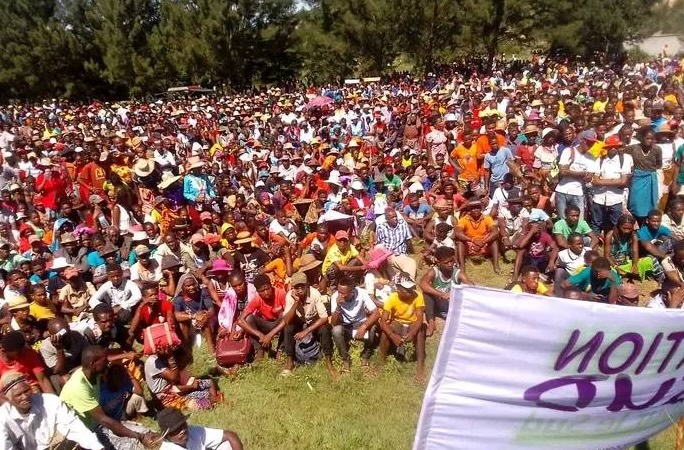
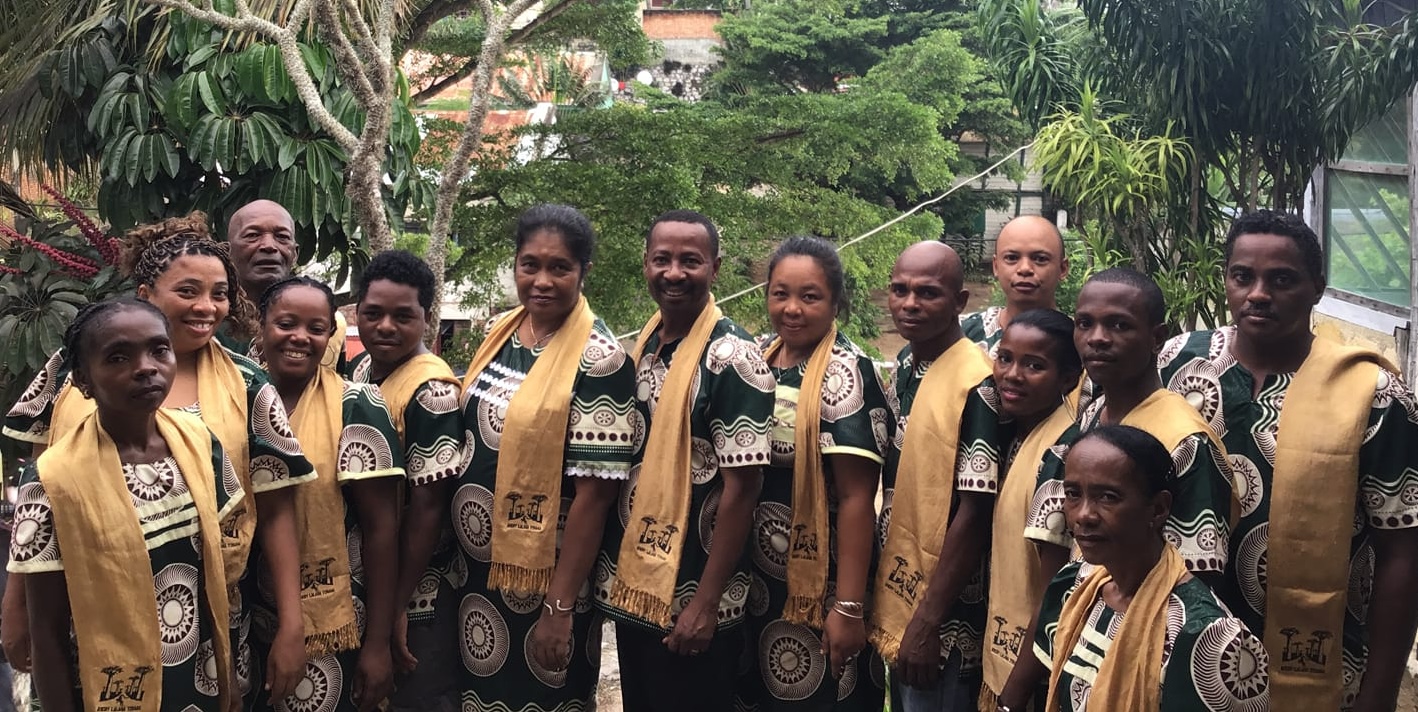
Gathering of Lusud in Anosy
QMM’s approach failed to produce meaningful resolution to the local issues and conflict. Instead, the conflict escalated into violence in October 2023 with the extrajudicial killings of three protestors. The protestors were demanding clemency for their association leaders who remain under arrest warrants for organising the June /July 2023 protests against QMM. There is still no inquiry into these killings and the company fails to recognise more than one of the protestor deaths – with no explanation as to why.
The shootings, arrests, incarcerations, fines and beatings of protestors, the lack of engaged dialogue and robust grievance and resolution processes, means that while QMM may have silenced and cowed an impoverished rural population around its mine site, all the time colluding with an administration that is actively repressing civil society with arbitrary detentions, it continues to fail on Corporate Human Rights Benchmarks , its commitments under UN Guiding Principles, and its claim of “community first”.
There is irony in the fact that an external platform (ROHY), which QMM insisted LuSud should attend (in place of a direct dialogue with QMM) convened with local people and concluded in its 2023 report that the socio-economic conditions of the surrounding communities of QMM, was “not yet tangible. Added to this are other issues that have been unresolved since QMM was set up“. These were the very complaints of LuSud, even though they did not attend so did not directly voice them at the platform.It does nevertheless suggest that LuSud’s demands were reflective of wider community concerns.
ROHY’s report highlighted “The urgent need to find sustainable solutions to the issue of water/water quality, which is the main cause of grievances, causing health problems and having a negative impact on fishing activities according to local communities”. They concluded that ” Strategic Environmental and Social Assessment (SESA) must be adopted as a working method to make (mining) investments justifiable“.
Assessments of any kind remain off the table at Rio Tinto for QMM. No matter who asks for them.
Those rural communities in Anosy who hold little hope their rights will be protected by their own government, await a door through which those who hold the power over their future can be pulled into the light – to be more transparently examined and, where necessary, held accountable to repair and remedy any harms or hardships for which they are responsible.

RIO TINTO AGM LONDON 2025 – RECORDING IS HERE (intervention by Valery Ramaherison of TI IMG asking about the assessment on QMM – at 1.37.25- 1.55.52 ) https://lumiagmukstreams.s3.eu-west-2.amazonaws.com/6.+Archive+2025/RioTinto/RioTinto+AGM+2025+(1080p).mp4